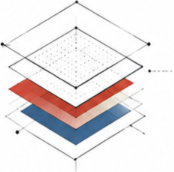
 Code from Spec
Part VI — The case for decomposition
The project was never one thing

The essay has asked its questions of "a project" as though one answer covered it: is the intent settled, does it fight the prior, does it live at the spec level or the source level, are its verdicts cheap or expensive. No real system answers uniformly. A business core still discovering what it owes shares a repository with a date formatter whose intent stopped moving years ago; an unconventional kernel that fights the prior on every clause links against glue code the prior writes for free. Every axis the earlier parts uncovered cuts through the system, and a system is heterogeneous on all of them at once.
Held as one region, a system has to be treated as one: its description answers to a single stopping rule, its oracle is driven to a single density, its artifact is resampled or preserved as a unit. Forced into one treatment, the whole is managed at the most expensive economics any part of it demands — the settled formatter carrying the moving core's uncertainty, the conventional glue paying the unconventional kernel's price.
Decomposition dissolves that. Draw a real boundary between two pieces and each becomes answerable on its own terms. A boundary buys two distinct things, worth separating from the start. The first: each piece sits at its own optimum on the axes, instead of the whole inheriting one piece's worst case. The second, narrower and treated further down: a move inside one piece can reach less of the system than the same move in a monolith could.
A component is the apparatus, nested
What makes answering per piece coherent is that a component is not a metaphor for a smaller version of the system; it is a smaller instance of the exact same structure: its own intent, its own description, its own generator, its own oracle, its own artifact accumulating its own survivor evidence, nested inside a larger one. Every question the previous parts asked of a project is asked again of each component, and answered independently. The primitives apply recursively, which is the whole reason a boundary can hold two pieces to different answers at all.
The axes of the cut
Where to draw a boundary is a question this essay has been answering in pieces since Part II. Each part uncovered an axis on which components differ, and every axis is read per component, never per project:
- Settled or moving intent. The oldest axis, and the first question of any cut. A piece whose intent stopped moving can have its description finished and its oracle driven dense; a piece still being discovered cannot. A component that straddles the line has no coherent economics: half of it wants a finishable description, half is still discovering what it is for.
- Conventional or unconventional intent. Where intent matches what the prior already resolves, the spec stays short and silence is safe; where intent fights the prior, every clause is expensive and load-bearing. A boundary that groups the conventional together costs almost nothing to describe; unconventional intent hidden inside a conventional component leaves its clauses competing with silence everywhere.
- Cheap or expensive verdicts. Components differ in what confirming a draw costs: a pure function with an exhaustive test suite on one side, behavior judged by human eyes on the other. Separated, the cheap side's draws are confirmed at the cheap side's price; mixed, the expensive verdict is obligated whenever a draw might have touched what it watches.
The rule the axes share: a boundary is well drawn when each side is homogeneous on the axes that matter, because every axis is a difference in economics, and a component that mixes two economics is managed at the more expensive one.
The three axes are independent. Two of them price the two halves of the apparatus: conventionality is the cost of the aim (does the prior do the work), verdict cost the cost of the confirmation (is there a mechanical oracle to run), and aiming and confirming were independent from the start. The third, settledness, is temporal — whether the referent holds still — and answers to neither cost. So the axes cross freely. A cryptographic primitive is unconventional yet cheap to verify, fighting the prior on every clause but pinned by test vectors; the visual polish of a UI is settled yet expensive, its intent fixed for years and its only oracle a human eye; a tax table that changes every quarter is moving yet cheap, each version a pure function with exact outputs. No one axis predicts another.
That independence is an instruction, not a curiosity. Homogeneity has to be read on every axis at once: a cut that makes both sides settled can still strand a mechanically verifiable core in the same component as a perceptual one, and the component is then confirmed at the perceptual price on every draw. A single boundary can satisfy one axis and violate another; only reading all three says which.
The interaction surface
The second gain is the easier one to overstate, so start with what decomposition does not buy. Componentization does not shrink the total dimensionality of a problem. The decisions a system has to make do not disappear by being split across files, and drawing a boundary between two components typically adds a few new ones at the seam: what the contract says, how a failure crosses it, what either side may assume about the other. The union of dimensions across every component is not smaller than the monolith's, and is sometimes slightly larger.
What shrinks is not the count. It is the interaction surface: how many other dimensions any given dimension can combinatorially entangle with. A monolith holds every dimension in one region, where a local move can, in principle, reach any of them. Partition the same dimensions into components with a real boundary between them, and a local move inside one component can only ever reach the dimensions inside it. The reachable set per move drops from the whole system to one component's share of it, even though nothing about the system's total complexity changed. Fewer dimensions to entangle with per box, not fewer dimensions overall.
What makes a boundary real
The instinct that a change confined to one component should only affect that component is correct exactly as often as the boundary drawn in the file structure is the boundary that actually governs the dimensions. When it fails (a change to interest calculation somehow breaks authentication), the failure always traces to the same thing: the two were never the same boundary. And the leak costs both gains at once — the containment the instinct assumed, and the separate economics the cut was drawn for: a dimension that crosses the seam ties the two pieces back into one region, and the cheaper side is dragged to the more expensive side's price.
A boundary is real to the extent that four things hold. No dimension crosses it through shared mutable state. A global variable, a shared table, an ambient config object read by both sides is a dimension that belongs to neither component alone, and a move that looks confined to one file can still reach it. The interface crossing it is narrow: few dimensions actually pass through. The failure domains are isolated: one side crashing or exhausting a shared resource cannot take the other down, which is a property of the runtime and deployment, not of the source tree. And the oracle covers both sides regardless of which one changed. Re-running only the "affected" tests, guessed from an incomplete dependency graph, can let a leak through the seam and report green. That is not evidence the boundary held, only evidence nobody looked.
Every one of the first three is a claim about where dimensions actually live, which the file structure asserts but does not enforce. None of this is a reason to distrust decomposition. It is the reason decomposition is a design decision with a real answer, not a free assumption. Draw the interface narrow, keep state unshared, isolate the runtime, verify both sides on every change that touches the seam. The instinct holds exactly as strongly as those four things do, no more and no less.
The classic levers, reread
Reuse, encapsulation, and the single-responsibility principle are usually taught as hygiene: don't repeat code, hide what callers should not see, give each unit one job. Under this theory each is a decision about a boundary, priced by the same economics as everything else.
Reuse is a decision about how many independent draws a subproblem gets. Partitioning decides how dimensions are grouped; reuse decides how many times a group gets drawn. Solve a subproblem once and reference the single result from every call site, and there is one artifact, one description, one oracle to ratify fixes into, and one accumulating record of survival. Solve it independently at each site (copy the logic, or re-derive it from scratch) and each copy is its own draw from the space, carrying its own defect set: the cost of resampling, triggered here by duplication instead of by time.
The copies' defects are not even uncorrelated: independent authors fail on the same hard inputs — the classic N-version programming result — and models trained on overlapping data correlate harder still. The same latent defect sits in every copy, and a fix ratified in one of them fixes exactly one of them. Cheap generation changes the shape of this cost without removing it: propagating the fix across N copies is now a cheap draw, but confirming N local moves and accumulating N records of survival is not. A draw is only as cheap as the confirming it obligates, and duplication multiplies the confirming.
Reuse also accelerates maturity. Every call site's traffic funnels through the same point, so the shared component faces the environment's verdicts far more often, per unit of time, than any one duplicate would alone. Solved once and shared, a subproblem matures at the rate of the whole system's use of it. Solved N times, it matures N times more slowly, with N different defect sets to eventually discover. At market scale the same funnel applies: a decades-old database has met more of the world than a fresh alternative will meet in a decade of your traffic, and adoption buys that record wholesale.
The cost that is genuinely reuse's own: a shared component answers to every caller's intent. When another caller's intent moves, the component moves for reasons this use case never had. That is drift imported through a dependency instead of discovered by the project itself. And where the component is the moving core itself — its intent proprietary and still being discovered — reuse inverts into a trap. A shared component encodes the market's intent, and adopting it resolves your silences toward everyone else's conventions. Adoption also forecloses ratification: a discovery about your own intent cannot be ratified into a component you do not own.
Encapsulation (hiding a component's internals behind a public contract) is a defense against Hyrum's Law, drawn structurally rather than promised by convention. Hyrum's Law says that with enough users, every observable behavior becomes something somebody depends on, whatever the contract says, and it bites on whatever is observable. A caller cannot grow a dependency on a resolution it cannot see. This buys something the other levers do not: internals can be resampled or restructured freely, accumulating none of the lock-in Hyrum's Law would otherwise impose, while the public contract keeps maturing on its own, its survivor evidence undisturbed. Internal churn and external stability are decoupled by the same wall that keeps a caller from seeing what it should not.
Single Responsibility narrows the component itself rather than just its visibility. A component that owns one concern has fewer behaviorally load-bearing dimensions bundled into one region, which moves three things in its favor. Diminishing returns on its spec arrive sooner and cheaper. Drift is contained: when the stakeholder concern behind one responsibility moves, only the component that owns it needs to change, and the survivor evidence accumulated by every unrelated component stays untouched. And the odds that a local move damages something unrelated drop as well: fewer nearby load-bearing dimensions to possibly touch.
The cycle cuts both ways
Read separately, each lever lowers the price of aiming, of confirming, or of both. Read together, under cheap generation, they compound into a cycle — and which direction it runs is decided by the boundaries.
Where the boundaries are real, it runs in the project's favor. Small, single-purpose, encapsulated components are cheap to describe (the delta is short and coherent), cheap to confirm (a dense mechanical oracle fits a small homogeneous piece), and — the part that matters most under generation — safe to resample one at a time, because a contract pins what a caller may depend on and a narrow seam caps what a fresh draw can disturb. That is exactly what a generation workflow needs: the expensive operation, the resample, made affordable at the grain of a component. And the cycle closes. What used to discourage fine decomposition was the human cost of one more module, one more contract, one more test suite on the seam — and, deeper, the cost of moving them. The right cut is learned by contact with the problem, not known at the start, so early boundaries are bets; when re-drawing one by hand cost everything the boundary had cost the first time, a wrong bet was close to permanent.
Cheap generation collapses both prices: the boundary gets cheap to build, and cheap to move once the problem teaches where it should have been. So the discipline that makes SDD safe is the same discipline SDD makes affordable: good boundaries let the generator work, and the generator pays for more good boundaries.
One term in the cycle does not collapse. What generation cheapens is implementing a boundary: the module, the contract, the suite on the seam are text, and text is what got cheap. Deciding where the boundary goes — reading the axes per piece, telling a real seam from one merely drawn — is the deciding share of authoring, the share no draw supplies and no oracle checks. And here it does not amortize: every boundary the generator makes affordable is one more placement somebody has to judge, so the cycle multiplies demand for the one input it does not cheapen. Choosing the boundaries is what decides which way the cycle runs.
Where the boundaries are false, the same machinery runs backward. A dimension leaking across a seam ties two components into one region again: every resample of one reopens the other, every cheap verdict is dragged to the expensive side's price, and cheap generation, far from helping, only finds the leak faster and ships defects through it. SDD does not reward good architecture and forgive bad; it amplifies whichever it is handed. Which is why decades of decomposition wisdom are not made quaint by a generator that writes the code — they are made load-bearing.